Who really goes abroad? Student mobility and social background
Click on the image to see full view
Research consistently shows that first-generation students remain underrepresented in international mobility. Closing this gap is a key priority of the Erasmus+ programme.
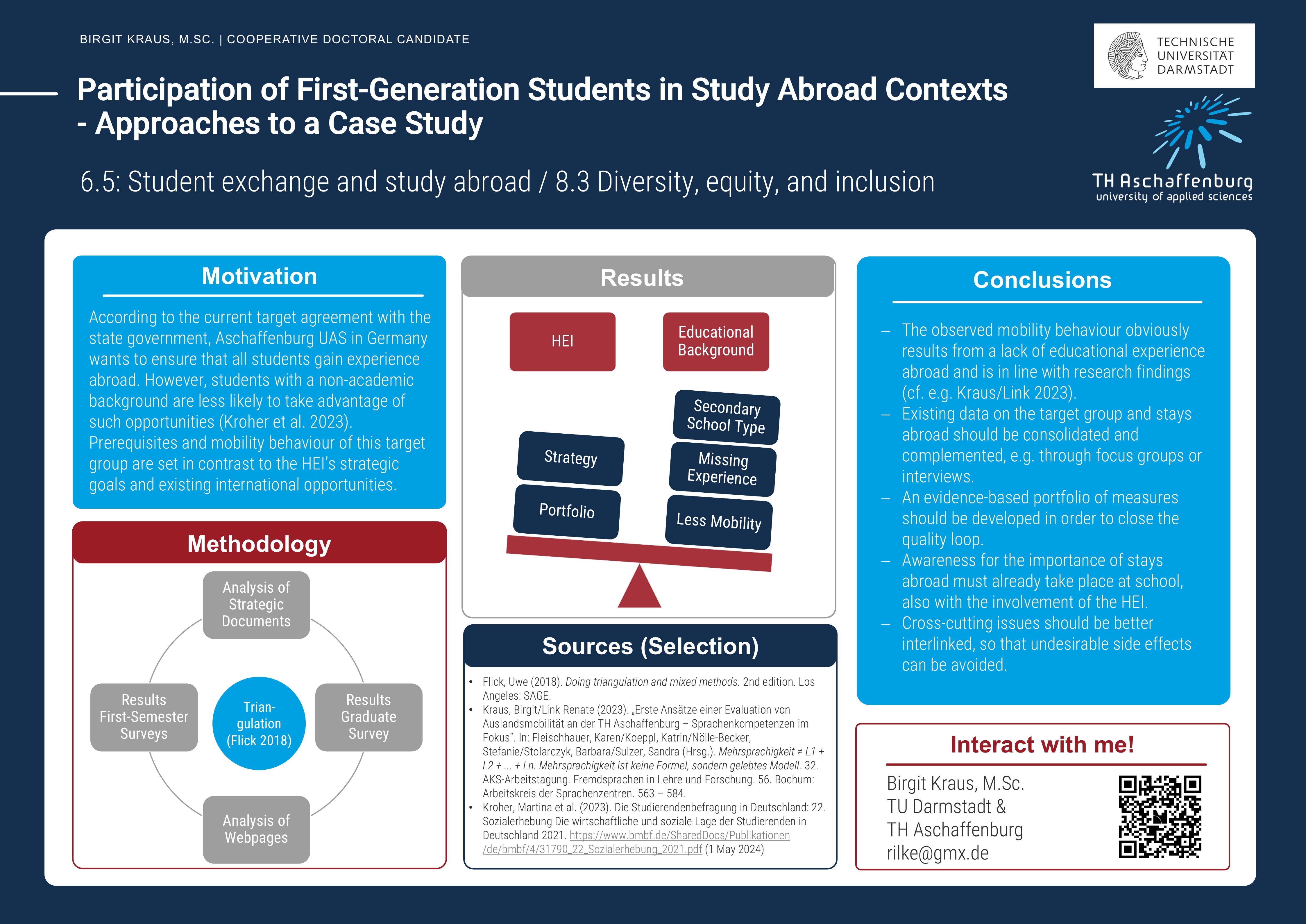
Based on survey data and institutional documents from Aschaffenburg University of Applied Sciences (Germany), this blog, inspired by a poster presented at the 35th annual EAIE conference and exhibition in Gothenburg, explores how students’ social background shapes international experiences before and during higher education.
At universities of applied sciences, around two-thirds of students come from non-academic families – a trend also visible in Aschaffenburg. At the same time, the HEI aims for all students to gain international experience during their studies. This ambition raises a crucial question: who participates in these opportunities?
A data-driven study
The analysis combines quantitative and qualitative sources. High-response first-semester and graduate surveys provide insights into educational backgrounds and mobility experiences. This data is complemented by strategic documents, development plans and internationalisation materials.
Four key issues guided the study:
- Goals regarding internationalisation and first-generation students
- Share of first-generation students gaining international experience
- Implemented measures
- First-generation graduates with studies abroad
While the dataset is unusually comprehensive, this remains an approach to a case study. Interviews and focus groups would deepen understanding of why students decide for or against studying abroad and how social background influences those choices.
Persistent gaps despite strategic approaches
Aschaffenburg UAS strongly emphasises student support, especially of first-generation students. However, explicit links between diversity and internationalisation are still limited, and measurable participation targets are missing.
Differences in international experience begin long before higher education. Since 2019, students from academic families have been roughly twice as likely to spend time abroad before enrolment. They more often complete expensive experiences such as a high-school year abroad, while first-generation students more frequently choose work-and-travel or au pair placements.
Despite extensive mobility opportunities, participation gaps continue during HE. Since 2020:
- 21.8% of graduates from academic families studied abroad
- 17.8% of first-generation graduates studied abroad
- Around 80% of all graduates did not go abroad at all
Financial barriers weigh more heavily on first-generation students. Students from academic families more often cite time constraints and organisational effort. The reasons for non-mobility are therefore complex and socially shaped.
A pathway to non-participation
These findings align with broader research on educational inequality in Germany. Different secondary school types are intended to reflect ability but often mirror social background. Schools attended by pupils from non-academic families typically offer fewer international opportunities and less encouragement to study abroad.
As a result, first-generation students often receive less support for longer stays abroad and are more likely to abandon their plans. Without early experiences, they may lack confidence or awareness of mobility opportunities later. This creates a pathway to non-participation that reinforces inequality.
From data to action
Addressing these disparities requires coordinated action:
- Awareness and proactive encouragement are crucial. Clear communication, targeted mentoring and early information can reduce perceived organisational barriers.
- Data should be systematically collected and enriched with qualitative insights. However, gathering data alone is not enough. It must lead to evidence-based action.
- Cooperation with schools can raise awareness of international opportunities before students enter higher education, increasing later participation.
Internationalisation and diversity should reforce each other rather than compete.
Towards internationalisation for all
International mobility offers transformative benefits, but access remains uneven. Structural and financial barriers affect first-generation students long before higher education begins.
If HE institutions truly aim to offer internationalisation for all, they must address these hidden inequalities. By using data strategically, strengthening school partnerships and embedding diversity within internationalisation strategies, studying abroad can become a realistic opportunity for every student.
Internationalisation and diversity should reinforce each other rather than compete.