
Shape the future of international education in Europe and beyond
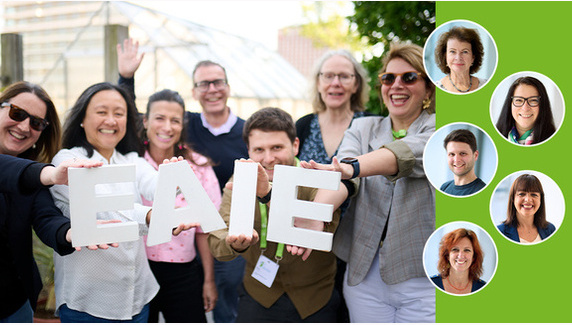
By becoming an EAIE volunteer, you step into a role where your experience can truly make a difference. You’ll join a vibrant community of peers who share your values, passions and commitment to making a difference. Through collaboration and connection, you can find inspiration, support and a sense of belonging that lasts well beyond the term.
2026 Roles at a glance
Thank you to everyone who applied! Applications for the following volunteer roles are now closed. Details about the positions remain available below so you can familiarise yourself with the structure, responsibilities and expected commitments. The next call for volunteers will be the call for General Council nominations in early 2027.
Thematic Committees
🧩 What are Thematic Committees?
Thematic Committees (TCs) are groups of volunteers who guide and shape the EAIE’s content across conferences, publications, training and community activities. As a TC member, you become a thought partner in your field, helping identify emerging trends and designing timely, relevant content for the EAIE community.
There are nine Thematic Committees, with seven individual roles in each group:
- European-funded programmes
- Leadership, strategy and policy
- Marketing and admissions
- Partnerships
- Social responsibility
- Student and alumni services
- Student and staff mobility
- Teaching, learning and curriculum
- Research on internationalisation
A great aspect of our Thematic Committee is the emphasis we place not only on professional collaboration but also on building personal relationships. In short, we’re having a great time while doing meaningful work!
⭐ Why volunteer for a Thematic Committee?
Volunteering on a Thematic Committee is a chance to:
- Influence: Help guide the themes and content that shape the EAIE’s conferences, publications and professional development offerings
- Grow: Develop professionally by working with peers beyond your own institution, gaining new insights, perspectives and skills
- Connect: Expand and strengthen your professional network across Europe and beyond
- Be inspired: Collaborate with a small, motivated group of colleagues who share your passion
Plus, as a volunteer, you enjoy additional perks such as:
- Reduced Annual Conference volunteer registration fee
- Travel and accommodation covered for in-person committee meetings
- The opportunity to form a supportive group of colleagues who often become genuine friends
📝 What you will do
As a TC member, you will contribute to the EAIE’s content portfolio through:
- Content review and development
- Reviewing conference session proposals relevant to your committee
- Designing Spotlight Sessions on hot or emerging themes in collaboration with the CPC
- Evaluating sessions during the EAIE Annual Conference
- Knowledge contribution
- Suggesting content for EAIE publications (Podcast, Forum, Blog, Research Snapshots)
- Sharing ideas for training topics and potential trainers with the Professional Development Committee
- Community engagement
- Supporting outreach and community-building activities via events and the EAIE Community Platform
- Identifying and cultivating potential content contributors
- Team collaboration
- Participating actively in your committee’s meetings and working collaboratively on group tasks
In terms of workload, you can expect steady engagement of about two days per month, along with a few predictable peak periods, mainly during the conference review cycle from mid‑November to early December. The workload is designed to remain manageable alongside a full‑time job.
You will also have:
- 4 meetings per year (minimum), online or in-person
- Preparation between meetings, depending on committee projects
- Collaborative tasks shared across the committee, distributed according to members’ calendars
✨ What you will bring
Ideal candidates bring:
- Expertise in your field: A strong professional background related to the committee’s topic area
- Open, creative thinking: You keep up with trends and can help shape meaningful content
- Connections and communication: You are well networked and comfortable engaging with the EAIE community
- Teamwork and intercultural collaboration: You enjoy co-creating with colleagues and bring strong interpersonal skills
- Commitment: You are ready to contribute your time, energy and enthusiasm for the full term
To ensure broad community representation within all Thematic Committees, we strongly encourage applications from professionals based in Eastern and Southern Europe, as well as early‑career professionals.
🔎 Explore the nine Thematic Committees
During your application to one of the nine committees, you will be asked to indicate which L2 and L3 topics within the group you consider yourself an expert in.
🟦European-funded programmes
Focuses on HE internationalisation initiatives funded at the European level.
The L2 & L3 topic areas linked to this area of expertise are:
- Erasmus+
- European Universities Initiative
- Horizon Europe
🏛️Leadership, strategy and policy
Centres on international office leadership, strategy, quality assurance, stakeholder engagement and governance issues.
The L2 & L3 topic areas linked to this area of expertise are:
- Academic freedom, ethics and integrity
- Knowledge diplomacy
- Advocacy and stakeholder engagement
- Internal stakeholder engagement
- External stakeholder engagement
- Crisis management
- International office management
- International rankings and benchmarking practices
- Language policies
- Quality assurance
- Regulatory compliance and accreditation
- Risk assessment
- Staff skill development
- Strategic planning
📣Marketing and admissions
Covers marketing, recruitment, admissions, credential evaluation and enhancing the student experience from first contact to enrolment.
The L2 & L3 topic areas linked to this area of expertise are:
- Admissions and recognition
- Admissions testing
- Credential evaluation
- Marketing and recruitment
🤝Partnerships
Focuses on institutional partnerships, including mobility, strategic alliances, collaborations, consortia, and transnational education.
The L2 & L3 topic areas linked to this area of expertise are:
- Capacity development partnerships
- Collaborative degree programmes
- Community and business partnerships
- Joint research and doctoral education partnerships
- Mobility agreements
- Strategic partnerships
- Associations, networks and consortia
- Transnational education partnerships
🌱Social responsibility
Focuses on DEI, sustainability, climate action, global citizenship, equity and decolonisation.
The L2 & L3 topic areas linked to this area of expertise are:
- Climate action and environmental sustainability
- Community engagement and dialogue
- Diversity, equity and inclusion
- Immigration, asylum and refugees
- Post-colonialism and decolonisation
- Global citizenship
- United Nations Sustainable Development Goals
🎓Student and alumni services
Addresses wellbeing, safety, accommodation, career support, employability and alumni engagement.
The L2 & L3 topic areas linked to this area of expertise are:
- Academic advising
- Alumni engagement
- Employability
- Career advising
- Internships, traineeships and work placements
- Student entrepreneurship
- Student accommodation
- Student safety and security
- Student mental health support
🌍Student and staff mobility
Covers exchange, short programs, internships, staff mobility, summer/winter schools and virtual mobility.
The L2 & L3 topic areas linked to this area of expertise are:
- Internships, traineeships and work placements
- Mobility service providers
- Short-term programmes
- Summer schools
- Staff mobility
- Student exchange and study abroad
- Virtual mobility
🧠Teaching, learning and curriculum
Explores curriculum internationalisation, language learning, COIL/virtual exchange, EMI, micro credentials and learning innovation.
The L2 & L3 topic areas linked to this area of expertise are:
- English medium instruction (EMI)
- Internationalisation at home
- Intercultural competencies
- Language learning
- Internationalisation of the curriculum
- Microcredentials
- Online, blended and hybrid learning
- Collaborative Online International Learning (COIL)
- Soft (transversal) skills
- Virtual exchange
📊Research on internationalisation
Examines research developments in IHE and the link between research and practice.
There are no specific L2 or L3 areas assigned to this TC, as research can cover any aspect of the taxonomy.
📄Download the full role description
You can download the full role description to gain a complete understanding of the responsibilities and time commitment involved, as well as an overview of the areas and topics each Thematic Committee specialises in.
Conference Programme Committee
🧩 What is the CPC?
The Conference Programme Committee works closely with the EAIE Board, Thematic Committees, and the EAIE Office to develop a high-quality, relevant and diverse conference programme. The CPC ensures that the programme reflects the main issues in the internationalisation of higher education across Europe and beyond.
Serving on the Conference Programme Committee has given me valuable insight into a much broader internationalisation landscape than my role normally covers. It’s strengthened my professional understanding of the sector. Review season is certainly busy, but it’s absolutely worth it when you see the Conference programme come together.

⭐ Why volunteer for the CPC?
As a CPC member, you’ll be one of the creative minds behind Europe’s largest international higher education conference—spotting emerging themes, inspiring new speakers and ensuring a high-quality, inclusive programme.
Serving on the CPC is a chance to:
- Shape the programme: Influence the direction and content of the EAIE Annual Conference
- Stay ahead of trends: Deepen your insights into emerging IHE developments
- Grow your network: Collaborate with expert peers from across Europe and the world
- Develop professionally: Hone your analytical, strategic and leadership skills
Plus, you enjoy additional perks such as:
- Reduced Annual Conference volunteer registration fee
- Travel and accommodation covered for in-person committee meetings
- The opportunity to form a supportive group of colleagues who often become genuine friends
📝 What you will do
As a CPC member, you will contribute to the success of the Annual EAIE conference through:
Programme development
- Review and make the final selection of programme elements (sessions, Ignites, posters)
- Ensure programme quality, balance and inclusivity for EAIE’s diverse community
- Use event evaluations and forecasting insights to shape future programmes
Committee-led sessions
- Contribute to and/or chair CPC developed features (e.g. Critical Conversations, EAIE Debate, Ignites)
Community engagement
- Support with hosting two webinars each autumn to promote the Call for Proposals and align the review process with Thematic Committee members
- Collaborate with the EAIE Office, Thematic Committees and the EAIE Board
In terms of workload, you can expect steady engagement throughout the year, with a peak during the conference review in November and December, all of which is manageable alongside a full‑time job.
|
Period |
Activity |
Format |
|---|---|---|
|
Nov–Dec |
Review 600+ proposals |
Individual review (peak time) |
| Dec | CPC meeting | In-person (2 days) |
|
Jan |
CPC meeting |
Online (1 day) |
|
Feb |
CPC meeting |
Online (1 day) |
|
May |
Joint Annual Meeting for volunteers (CPC strategic planning) |
In-person (3 days) |
|
Sept |
Conference participation & programme support |
In-person |
✨ What you will bring
We’re looking for candidates with the following experience and skills:
Professional experience
- Broad knowledge of International Higher Education (IHE) and regular participation in the EAIE Annual Conference
- Current EAIE member with prior involvement (e.g. trainings, volunteering, submitting proposals, or consistent conference attendance)
Core competencies
- Strong analytical and decision-making skills; able to assess diverse topics and reach balanced conclusions
- Excellent interpersonal and intercultural communication skills; collaborative mindset
- Sound judgment, integrity and resilience; able to explain decisions clearly
- Reliability and time management; able to meet deadlines and attend all meetings
- Open-minded, proactive, globally oriented and well-connected
- Strong written and oral communication, including comfort with digital collaboration tools
Diversity and skills mix
- All eligible EAIE members are welcome to apply
- We are seeking to establish a diverse committee that represents all fields and regions of international higher education, so anyone interested in the role is encouraged to apply
📄Download the full role description
You can download the full role description to get a complete understanding of the work and the commitment involved.
Board

🧩 What is the Board's role?
The EAIE Board guides the future of the Association. As an executive body, Board members shape and implement the EAIE’s strategy, oversee programmes and services, and ensure our work aligns with our long‑term vision. They provide oversight, uphold the organisation’s public standing, and remain closely connected to the General Council and the Thematic and Functional Committees to stay attuned to the organisation and to adjust and evolve its activities.
In addition to fulfilling all standard Board responsibilities, the Vice-President assists the President in providing Board leadership, engages with the Executive Director on strategic and time‑sensitive topics, and represents the association when required.
⭐ Why volunteer for the Board?
Volunteering as a Board member places you at the centre of the EAIE’s work and impact. It’s an opportunity to advocate for the international education sector, influence strategic goals, and contribute to the EAIE’s legacy.
The benefits of serving include:
- Professional recognition and visibility across the EAIE community and the wider sector
- High‑level networking opportunities that open doors for you and your institution
- A chance to shape the field, respond to current issues, and inspire others
- Active involvement in strategic decisions that influence the future of the Association
Plus, practical perks include:
- Reduced conference fees
- Travel and accommodation covered for in-person Board meetings
For the additional time commitment, compensation is provided to the Vice-President’s employer.
📝 What you will do
The Board’s primary focus is governing the Association. This includes providing financial oversight of the organisation and regularly monitoring and evaluating its programmes and services to ensure they remain aligned with the strategic plan.
Board members play an active leadership role in governing the Association and supporting its long‑term success.
Your key responsibilities:
- Oversee programmes, services and finances to ensure alignment with the strategic plan
- Communicate regularly with the Executive Director, EAIE Office, volunteers and the wider community
- Liaise with EAIE Committees to ensure strong connections across the Association. Except for the President and Vice President, each Board member is appointed as a liaison to three Thematic Committees and one Functional Committee
- Represent and promote the EAIE’s mission and values publicly
In terms of workload, serving on the Board is a meaningful and active commitment. While it can be managed alongside a full‑time job, Board members, particularly the President and Vice‑President, are expected to provide regular insight and guidance in addition to attending scheduled meetings.
You can expect to:
- Attend at least five Board meetings per year, some of which may last up to two days. Most meetings take place in Amsterdam (February, April, June, September, during the Conference, and November)
- Attend two General Council meetings each year (May, during the Joint Annual Meeting, and December), as well as possible additional meetings with focus groups on dedicated topics
- Prepare for and present at volunteers’ meetings, including the Joint Annual Meeting in May and 1–2 meetings with the Thematic and Functional Committees for which you act as liaison
- Allocate time for meeting preparation and actively contribute to discussions
- Respond to Office requests via email regularly
The role of Vice‑President requires additional time investment, including regular communication with the President and Executive Director via biweekly meetings and chairing meetings when the President is unavailable. The role also involves representing the Association externally, including travel for conferences and other related projects.
✨ What you will bring
We welcome dedicated leaders who can inspire, collaborate and contribute strategically to the EAIE’s mission.
We are looking for candidates with the following experience and skills:
- Proven experience in international education and a track record of contributing their skills to programmes, initiatives or projects
- Strong problem‑solving and decision‑making abilities, including navigating unexpected challenges
- Strategic, visionary thinking with the ability to see connections across the organisation
- Teamwork and intercultural communication skills, and a strong commitment to EAIE values
- Sound judgment and integrity, with the ability to prioritise the greater good of the Association
📄 Download the full role description
You can download the full role description to get a complete understanding of the work and the commitment involved.