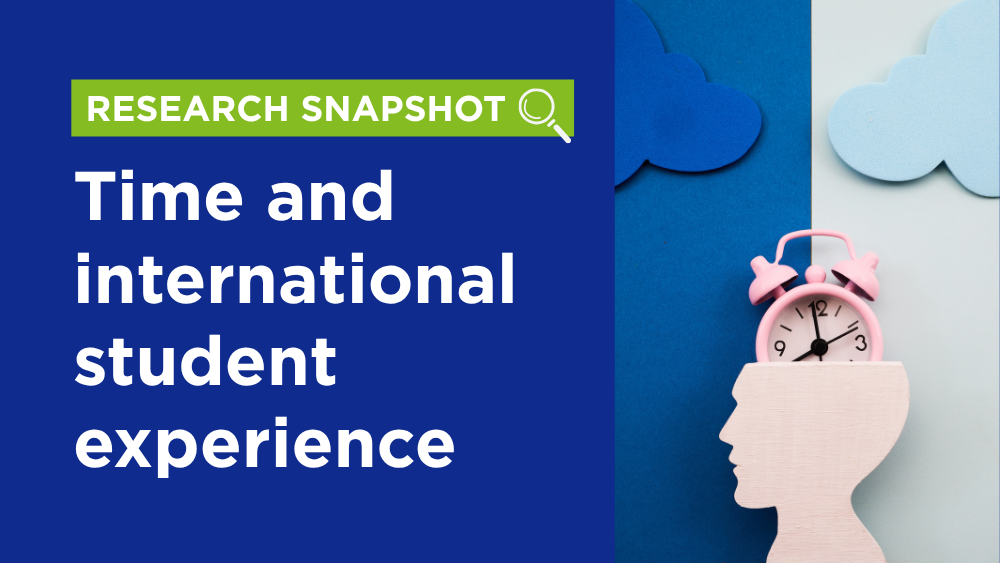
Research Snapshot: Time and international student experience
The strange times of international studentship: A comparative study of the United Kingdom, Denmark and Germany
Publication date: 10 February 2026
This paper draws on Vera’s doctoral research conducted across the UK, Denmark and Germany. The project examined how knowledge is valued and whose knowledge counts within international student mobility, using creative and participatory methods. Building on this work, Vera and Sazana developed the article collaboratively.
The paper focuses on time, an often-overlooked aspect of international student mobility. It explores how different experiences of time shape students’ learning, their progression through higher education and their broader life paths. Differences in academic calendars, institutional expectations and national higher education systems all matter. The analysis shows how growing pressure to study quickly and complete on time affects students’ experiences, while also highlighting how students create their own ways of organising time and understanding the value of higher education.
This research shows how international students manage study and life timelines, highlighting their creativity, unlearning and agency across different higher education systems.
Vera Spangler
Vera Spangler is a postdoctoral researcher at the University of Copenhagen and a social anthropologist. Her work explores how knowledge is valued and constructed across different countries and higher education systems, with a focus on international student mobility and global inequalities. She uses creative and participatory methods, informed by decolonial and spatial perspectives.
Sazana Jayadeva
Key findings of the research:
This research highlights the importance of time in shaping international students’ experiences and its implications for higher education practice. Students navigate different academic rhythms, institutional expectations and prior experiences of time as they move across systems. In doing so, they actively negotiate, adapt, resist or reshape study timelines, showing how institutional structures and individual life paths intersect.
Differences between national systems matter. In Denmark and Germany, more flexible timelines can support deeper engagement and exploration. In contrast, the UK’s intensive one-year programmes often prioritise speed and completion, limiting opportunities for slower, more reflective learning. How students respond depends on their previous experiences, cultural expectations and available resources, meaning these conditions are not experienced equally.
Moving across countries can disrupt familiar patterns of time, creating space to rethink how learning, work and life are organised. Focusing on time reveals the limits of policies centred on speed and completion, and points to the need for more flexible and inclusive approaches.