A practical guide to citizen-centred engagement: Insights from YUFE

The idea that higher education institutions should actively contribute to society is no longer abstract – it is a practical responsibility in today’s rapidly changing world. The experience of the Young Universities for the Future of Europe (short YUFE) alliance offers concrete lessons you can apply directly to your own work, whether you are an educator, researcher or administrator. YUFE is a consortium of ten research-intensive higher education institutions, all founded after the Second World War. Together they aim to shape a holistic and inclusive future for European students and learners, and their society. Furthermore, they want to support Europeans to become globally oriented lifelong learners, equipped to make meaningful contributions to the communities in which they live, learn and work.
Community engagement as a conscious choice
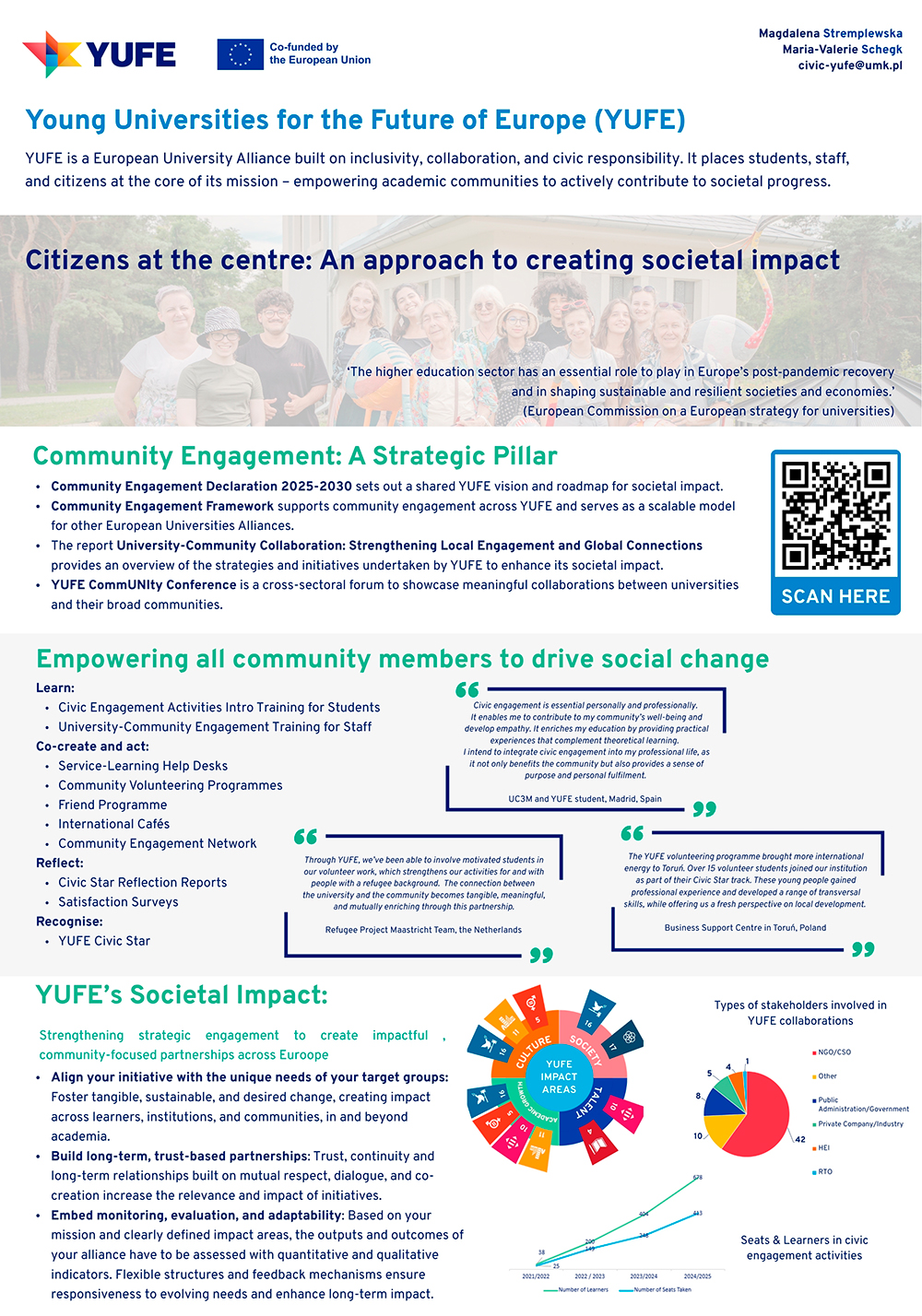
Let’s start with the importance of treating community engagement as a strategic priority rather than an additional activity. At YUFE, this echoes in documents such as the Community Engagement Declaration 2025-2030 and the Community Engagement Framework. In practice, this means linking engagement activities to broader goals and connecting them with teaching, research or policy-related work, rather than treating them as stand‑alone initiatives.
Another important element is the combination of training, action, reflection and recognition as a coherent cycle. YUFE structures its activities around these four components, which can serve as a useful model. For example, before launching a community-based initiative, consider whether participants have the necessary preparation (training). Then ensure there is space for implementation (co-creation and action), followed by structured reflection (evaluation of outcomes), and finally recognition (acknowledgement of contributions). Applying this cycle can make your initiatives more complete and sustainable.
Practical formats, networks and evaluation for sustainable community engagement
YUFE also demonstrates a range of practical formats that can be adapted elsewhere. Service‑learning help desks demonstrate how students and staff can engage with communities and offer their expertise. Community volunteering programmes developed in collaboration with NGOs or municipalities show how transversal skills can be honed while contributing to resolving local challenges. Smaller initiatives, such as informal intercultural meetings, can also help strengthen inclusion and mutual understanding. Another important insight concerns the value of networks that extend beyond a single institution. Our Community Engagement Network offers one possible approach, enabling knowledge exchange across regions while staying attentive to local realities. Another is the CommUNIty Conference, serving as a space to showcase and enhance YUFE university-community cooperation.
Finally: evaluation and feedback. Reflection reports and citizen satisfaction surveys help capture both learning outcomes and community perspectives. Combining qualitative feedback with measurable indicators can support learning and improvement.
From lessons learnt to adaptable principles
In short, the lessons learnt from YUFE can be turned into very practical actions. Ensuring activities really match the needs of their target groups can start with early consultations or co-design. Building long‑term partnerships means working consistently with the partners over time. Presenting results with reference to well‑known frameworks, such as the Sustainable Development Goals, can make your work easier to comprehend and more relevant to a wider audience. Staying flexible helps initiatives respond as needs shift over time.
Overall, the YUFE experience, rather than offering a fixed model, suggests a set of principles that can be adapted in different contexts. Whether applied within a single course, a research project, or at the level of institutional strategy, they can serve as a reference point when you seek to strengthen the societal dimension of your work. By placing citizens at the centre of an alliance’s work, one not only enhances its relevance and impact but also helps build stronger, more connected and more resilient societies
By placing citizens at the centre of an alliance’s work, one not only enhances its relevance and impact but also helps build stronger, more connected and more resilient societies.