Member-only resource

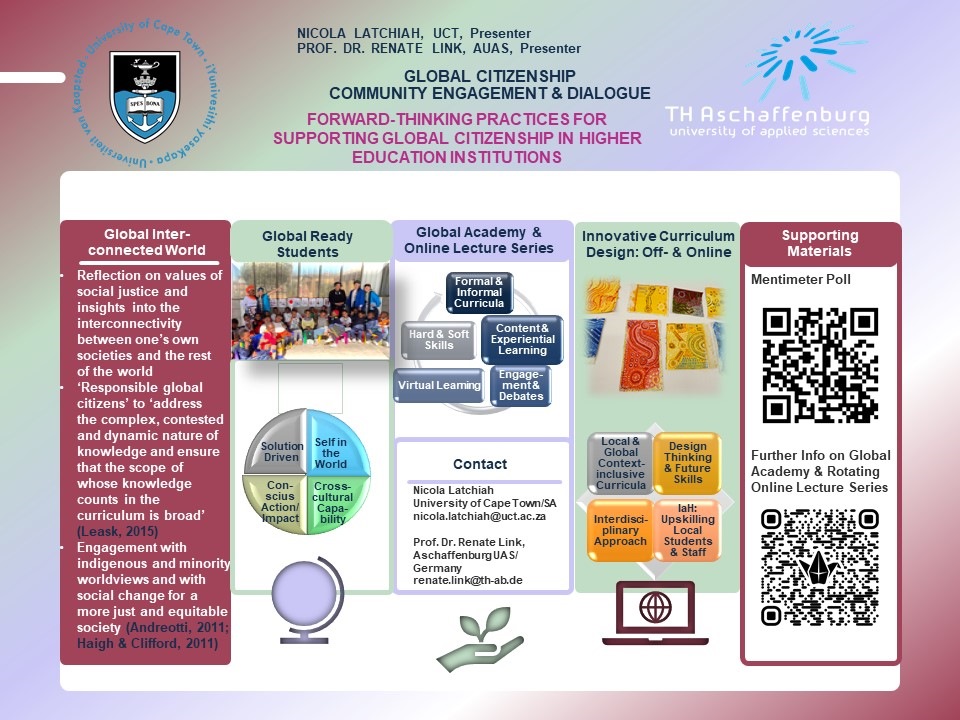
As higher education institutions (HEIs) navigate an increasingly interconnected world, the role they play in shaping globally minded citizens has never been more important. This poster presented at the 35th Annual EAIE Conference and Exhibition in Gothenburg highlights two forward-thinking initiatives that offer practical, adaptable approaches for embedding global citizenship into university life whether on campus or online.
The University of Cape Town in South Africa and Aschaffenburg University of Applied Sciences in Germany have both launched innovative programmes aimed at cultivating a deeper sense of global responsibility, inclusion and critical engagement among students and faculty. Their approaches, while contextually different, share a commitment to experiential learning, dialogue and social justice.
The Global Academy, developed by the University of Cape Town, is a multi-faceted programme that blends interdisciplinary coursework with real-world community engagement. Participants – both students and faculty – are challenged to explore global interdependencies through a critical lens, engaging with issues such as inequality, climate justice and systemic discrimination.
What sets this initiative apart is its holistic structure: it combines academic theory with hands-on collaboration and peer learning. By encouraging active participation with local communities, it bridges the gap between global awareness and local action. This is particularly valuable for institutions looking to move beyond textbook definitions of global citizenship towards something more impactful and lasting.
What can you take away? Consider how your institution might embed community engagement into globally focused curricula. You do not need to replicate the entire Academy – start by integrating real-world case studies or inviting community leaders into the classroom to discuss local-global intersections.
Meanwhile, Aschaffenburg University’s online lecture series uses technology to flatten borders and expand dialogue. Experts from a range of disciplines are invited to speak on critical global topics – from climate change to economic inequality – in an accessible, rotating format. What’s particularly noteworthy is the strong emphasis on student participation: sessions are designed not as passive webinars but as forums for discussion, analysis and reflection.
The virtual structure enables broad accessibility while maintaining high levels of interaction. This format also allows institutions with limited resources to offer global content without needing extensive infrastructure.
A takeaway for your institution? If you're already running guest lectures or short courses, think about how you could expand access and engagement by taking them online and opening them up to international collaborators. Encourage students not just to attend, but to participate— by submitting questions, leading discussions or even co-hosting sessions.
Whether you are building new curricula, designing co-curricular activities or enhancing virtual learning, these models illustrate how we can move from aspiration to action in promoting global citizenship.
What ties these two initiatives together is their commitment to inclusive, participatory learning. Both the Global Academy and the lecture series embed elements of social justice, emphasise design thinking and future skills and seek to empower students as active contributors to global conversations.
For HEIs seeking to prepare students as future global leaders, these programmes offer a compelling blueprint. Whether you are building new curricula, designing co-curricular activities or enhancing virtual learning, these models illustrate how we can move from aspiration to action in promoting global citizenship.