It takes a community: piecing together a joint master’s programme
More details about the TRACEE programme can be found here.
Eleven higher education institutions, two African partners, a diverse academic community – and one shared ambition. That’s how the first pieces of the CIVIS Master’s in Transdisciplinary Studies of Climate, Environment, and Energy (TRACEE) began to fall into place. Some fit neatly. Others need sanding, stretching or flipping upside down. And just when we thought the picture was complete, new pieces appeared.
That’s the reality of building a joint master’s programme: the picture evolves as you go. In TRACEE’s case, the evolving image is one of a truly global learning community, preparing graduates to tackle climate, environment and energy challenges from multiple disciplinary and cultural perspectives.
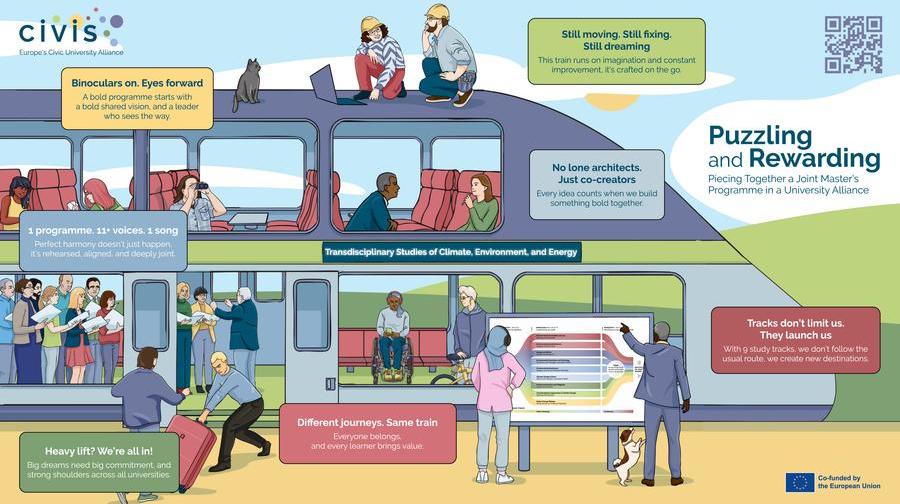
Our poster, which is one of the winning posters presented at the EAIE 2025 Conference and Exhibition in Gothenburg, distils that journey into seven "puzzle pieces" – each a practical lesson from the frontlines of joint programme development.
1. Binoculars ready. Eyes forward.
TRACEE began with a bold idea from a visionary academic – a call to tackle climate, environment and energy challenges through true transdisciplinarity. The vision of this programme is for students with a solid disciplinary background to become transdisciplinary graduates capable of tackling some of the world's most pressing challenges — climate change, energy transitions and environmental crises. That vision has been carried forward by committed champions across multiple institutions, kept us on course even when navigating complex national regulations and competing priorities. Strong leadership ensured the "big picture" stayed visible, guiding daily decisions without losing sight of the long-term destination.
Practical Tip: Identify leaders who can hold the vision, inspire others and communicate it often enough so it becomes a shared compass for the whole team.
2. 1 programme. 11+ voices. 1 song.
Perfect harmony doesn’t just happen – it’s rehearsed. In TRACEE, regular cross-partner meetings, transparent decision-making and a commitment to listening ensure no voice is lost in the chorus. Over time, this rhythm of collaboration has built trust and alignment, turning diverse perspectives into a shared, coherent vision.
Practical tip: Create a governance rhythm that’s predictable, inclusive, transparent and designed to keep everyone’s contribution in tune.
3. Heavy lift? We're all in!
Joint programmes demand more than enthusiasm – they require sustained commitment of time, people and resources from every partner institution. That level of engagement isn’t always clear at the outset, but it becomes essential as the programme takes shape.
Practical tip: Be upfront about long-term commitments early, so partners can prepare and fully invest from day one.
4. Different journeys. Same train.
TRACEE brings together students with diverse profiles, experiences and aspirations. Our nine study tracks allow each learner to tailor their academic path while ensuring everyone shares a strong common foundation. This approach embraces inclusiveness in all its forms and responds to different learning needs, ensuring every student can thrive and contribute.
Practical tip: Design flexible pathways that value diversity as a core strength and adapt to a range of learner profiles.
5. Tracks don’t limit us. They launch us.
In TRACEE, the nine study tracks are not rigid lanes but springboards for creativity. Students share a common journey in the first semester, building a strong cohort identity, before branching into different specialisations across partner institutions. This blend of shared experience and flexible pathways allows them to explore unexpected module combinations, collaborate across tracks and build unique expertise that reflects both their interests and the programme’s transdisciplinary spirit.
Practical tip: Combine a solid shared foundation with multiple pathways for progression, so students remain part of a cohesive community while pursuing their own academic passions.
6. No lone architects. Just co-creators.
TRACEE has been shaped by academics, administrators and students working side by side. This diversity of perspectives not only strengthened the design but also uncovered ideas and solutions no single group could have imagined alone. Co-creation built trust, shared ownership and a programme that truly reflects its community.
Practical tip: Bring all stakeholders into the room early – physically or virtually – and keep them engaged throughout development.
7. Still moving. Still fixing. Still dreaming.
With TRACEE launched, the work hasn’t stopped – it entered a new phase. We’ve refined mobility patterns, adjusted learning outcomes and added new collaborative projects, each shaped by feedback from students, staff and partner institutions. This ongoing evolution keeps the programme relevant, responsive and ambitious, ensuring it grows alongside the needs of its learners and the world it serves.
Practical tip: Build review points into your timeline so adaptation is expected, welcomed and built into your programme’s culture.
What you can take away.
The most important thing we’ve learned? A joint programme is less a finished product than a living ecosystem. It thrives when nurtured by a whole community – academics, administrators, students and external partners – all contributing their expertise and perspectives.
If you’re considering your own joint programme, take this to heart:
- Lead with vision. Agree on a bold purpose early and return to it when decisions get tough.
- Build with many hands. Distribute both responsibility and credit widely.
- Plan for change. Treat adaptability not as a last resort fix, but as a built-in strength.
Whether the subject is climate studies or cultural heritage, medicine or media, these TRACEE puzzle pieces can help you transform complexity into opportunity.
A joint programme is less a finished product than a living ecosystem. It thrives when nurtured by a whole community – academics, administrators, students and external partners – all contributing their expertise and perspectives.