Member-only resource

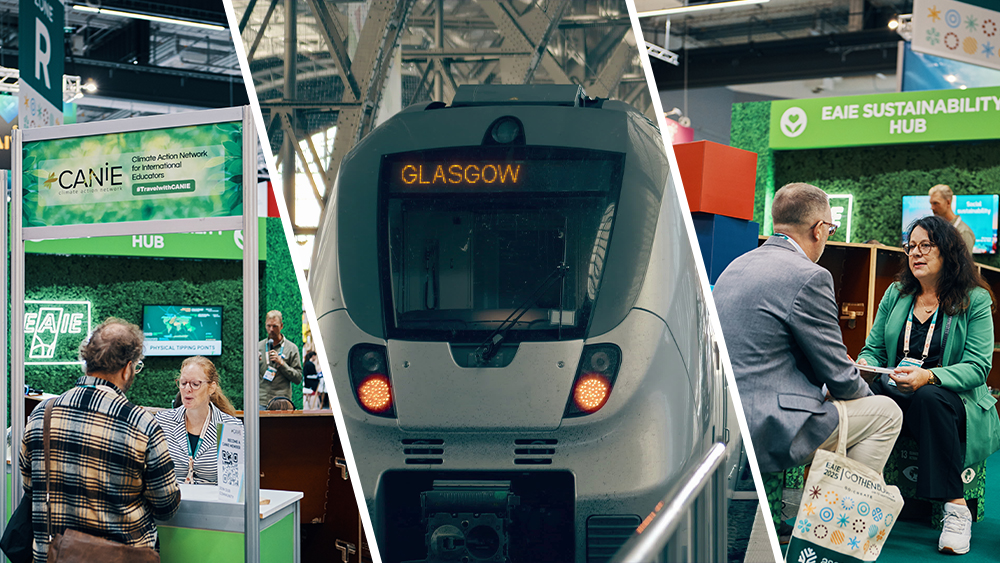
What does choosing a more sustainable journey look like in practice? As part of our Travel With CANIE initiative, we're highlighting the experiences of two participants travelling to EAIE Glasgow 2026 by train instead of plane. The initiative is part of the EAIE's ongoing collaboration with CANIE following our commitment to the CANIE Accord, which unites the international education sector around a shared commitment to climate action. As more people seek low-carbon travel, their stories show how small choices can contribute to a more sustainable future for our sector.
We sat down with Paulina Swann (Senior Global Mobility Manager at Nottingham Trent University, UK) and Els Jacobs (International Affairs Advisor, TU Delft, Faculty of Applied Sciences), who shared what they hope to gain from travelling green to Glasgow.
Paulina: There are two reasons, really. The first is institutional—at NTU, our policy encourages train travel for European journeys wherever possible, and for travel within the UK, this is very achievable. The second is a personal choice. I try to avoid flying whenever I can and opt for lower-carbon alternatives like train travel. It’s a conscious decision I enjoy making, and one that aligns with my values
Els: I choose to travel sustainably where possible to reduce my carbon footprint. Glasgow can easily be reached by train from Rotterdam, where I live, in one day. I also greatly enjoy the experience of ‘slow travel’ since it not only allows you to gain a better sense of and perspective on the actual travel distance but also to feel the transition from one country & culture to another.
Paulina: This isn’t my first time travelling by train to EAIE. I previously travelled from the UK to Toulouse by train for the 2024 conference.
Els: I have done this before, also longer distances, and the experience so far has been positive!
Paulina: I haven’t booked my rail tickets yet, but I’ve researched the route. The journey should take around 5½ to 6 hours, with ideally just one change. One challenge in the UK can be reliability; delays do happen, and there’s always a chance of missing a connection. But I take that as part of the journey.
Els: Rotterdam to Glasgow (with stops in London and Edinburgh).
Paulina: I completely understand why some people feel that way. For some, it’s about time constraints; for others, it may be childcare responsibilities, mobility issues, or the physical challenge of a longer journey. It’s also about being part of a wider shift. What CANIE has started is becoming a real movement, and there’s a growing community of people choosing to travel this way. Being part of that feels meaningful, and every small action contributes to a larger impact.
Els: Yes, it may take longer to travel by land, but it sure is a very rewarding experience! Not only do you reduce your carbon footprint immensely, but it also makes the conference experience much more fulfilling. I advise you to prepare early, convince your manager with good arguments, and set an example in international education.
Paulina: It already is, whenever it’s feasible. Train travel is my first choice, and I consider other options only if necessary. I think it’s important that we lead by example. The more we do that, the more it becomes part of how people naturally plan their journeys.
Els: Yes, it already is! 😊
As Paulina and Els have shared, choosing a more sustainable way to get to Glasgow doesn’t mean compromising on the experience. Sometimes, slowing the journey down offers the chance to arrive feeling ready for what’s ahead. We hope their stories inspire you to consider the options available and discover what works best for you.
Excited to make your journey part of the change? Join the Travel with CANIE movement and help shape a more sustainable future for international education. In the meantime, read more about our sustainability efforts at EAIE Glasgow 2026 and explore practical tips to help you plan your journey. We look forward to welcoming you to Glasgow!
Booking: Many countries offer reduction cards, which will save you a considerable amount of money, complete with a "miles" system where you can achieve benefits such as lounge access or upgrades (Germany: Bahncard, France: Carte Advantage Adulte, Switzerland: TravelPass, UK: BritRail -ACP rail).
Lastly, long journeys are cheaper if you book them through the train website of another country. If you are travelling across borders, make sure to compare prices.