Research Snapshot: University as a melting pot

University as a melting pot: Long-term effects of internationalisation
Publication date: 01 Oct 2026
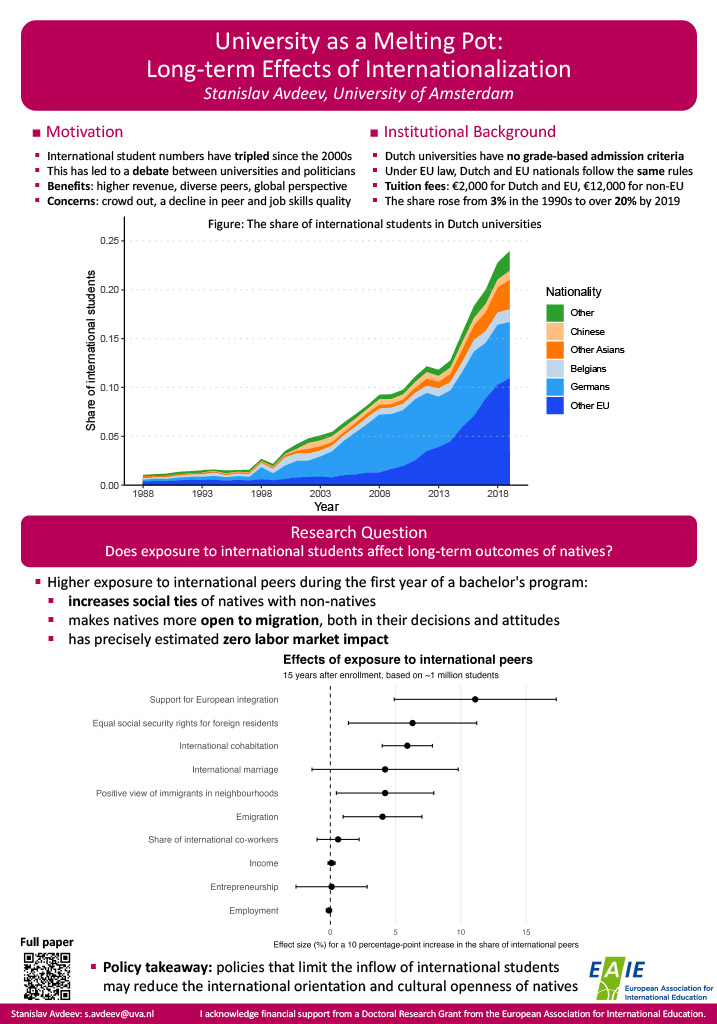
I conducted this research to examine whether exposure to international students affects the long-term outcomes of native students. The study combines nationwide administrative and survey data from the Netherlands, covering more than one million students enrolled between 1988 and 2019. The analysis compares native students in the same field and institution, but in different cohorts with different first-year shares of international students. This approach allowed me to estimate long-run social, attitudinal and labour-market outcomes while avoiding comparisons across different programmes. The motivation is simple: policy debates increasingly restrict international student inflows, but the evidence on how international peers influence native students is limited.
Internationalisation changes who native students connect with and how open they become, without compromising their long-term labour-market outcomes.

Stanislav Avdeev
Stanislav Avdeev is an empirical microeconomist with a strong interest in the economics of education and health. His research focuses on the quasi-experimental estimation of policy reforms using administrative and survey data. He is a PhD candidate in Economics at the University of Amsterdam. His advisors are Hessel Oosterbeek and Bas van der Klaauw.
Key findings of the research:
- First, exposure to international students increases native students' social ties with non-natives. A 10 percentage-point increase in the first-year share of international student raises the probability of cohabiting with a non-native by 5.9%, marrying a non-native by 4.2%, and emigrating by 4.0% fifteen years after starting higher education.
- Second, the effects are not limited to direct contact within the classroom. Native students form ties beyond their programme and institution, and survey responses show more positive attitudes towards migration, foreigners and European integration. This pattern supports a preference-shift mechanism rather than simply increased opportunities for interaction.
- Third, I find precisely estimated zero effects on employment, income, entrepreneurship and the share of international co-workers up to 25 years after entry. For international educators, these findings suggest that internationalisation should be evaluated not only through recruitment, funding or labour-market metrics, but also through long-run social integration and cultural openness among native students.