True crime: Admissions fraud
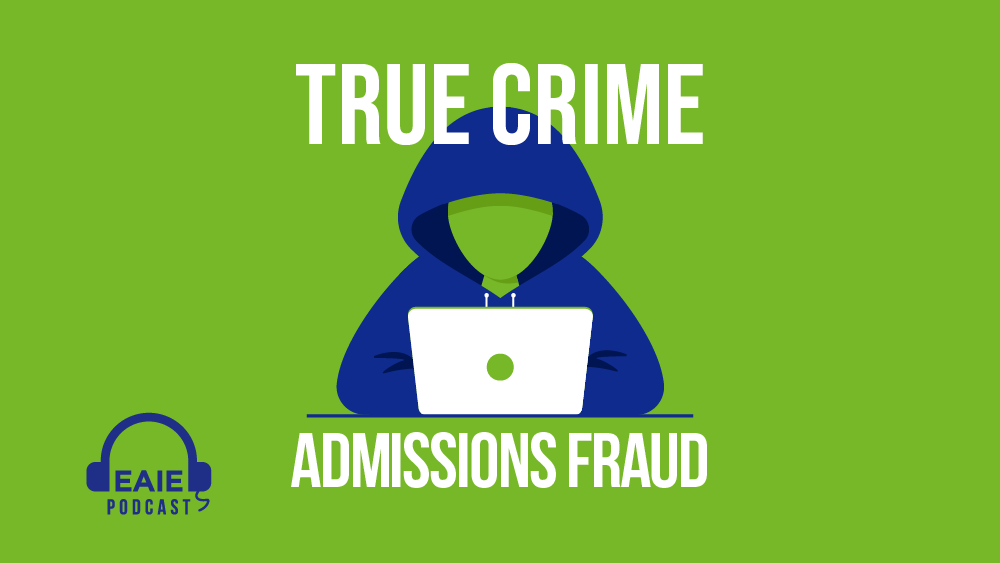
International student admissions are built on trust, but what happens when that trust is put to the test? From fake documents and misleading applications to the growing influence of AI and other digital tools, admissions fraud is becoming an increasingly complex challenge for higher education institutions around the world. How common is it really? Are there myths that practitioners should stop believing? And can institutions keep pace with ever-evolving fraud tactics?
In this episode of the EAIE Podcast, host Laura Rumbley is joined by Amy Kawa, Muriel Poisson and Elena Denisova-Schmidt to investigate the world of admissions fraud. Together, they explore what current research and practice tell us about the issue, examine how technology is reshaping the fraud landscape, and share practical strategies institutions can use to strengthen their admissions processes. Tune in for a fascinating conversation that separates fact from fiction and looks ahead at the future of admissions integrity.
About Amy Kawa
Amy Kawa is the Director of Evaluation Services at Educational Credential Evaluators (ECE), where she has been part of the organisation since 2016. She began her tenure at ECE as an Evaluator and has since advanced through leadership roles, bringing deep expertise in credential evaluation and policy development. Her main areas of interest in evaluation include Afghanistan, Francophone Africa, and Middle Eastern countries, though she has a broad understanding and appreciation for global education. In her current role, Amy oversees evaluation operations and contributes to strategic planning. Prior to joining ECE, Amy worked in multiple areas of higher education, which continues to inform her collaborative, globally-focused approach to credential evaluation work.
About Muriel Poisson
Muriel Poisson is the acting Team Leader for the Knowledge Generation and Mobilization (KGeM) team at the International Institute for Educational Planning (IIEP, part of UNESCO). In this capacity, she coordinates and develops the Institute’s foresight, research, communication, publication, and library functions. She also manages the Institute’s capacity-building programme on Ethics and Corruption in Education. She coordinated several international research projects on related issues, including open school data, open government in education, and teacher codes of conduct. She is also managing ETICO, a dynamic clearinghouse on transparency and accountability issues in education. Muriel has authored a number of articles and books, including: ‘Corrupt Schools, Corrupt Universities: What Can Be Done?’
About Elena Denisova-Schmidt
Elena Denisova-Schmidt is a Privatdozentin at the University of St. Gallen (HSG), Switzerland. She has held academic appointments at various institutions, including Humboldt University of Berlin (2002–2007), the Edmond J. Safra Center for Ethics at Harvard University (2013–2015), and the Aleksanteri Institute at the University of Helsinki (2015). She was a Research Fellow at the Center for International Higher Education (CIHE) at Boston College from 2015 to 2026, a Visiting Professor at Shanghai University (2025–2026), and a Visiting Researcher at the UNESCO International Institute for Educational Planning (IIEP) in Paris (2026). In 2026, she received the European Network for Academic Integrity (ENAI) Exemplary Research Award for her contributions to research on academic integrity and corruption in higher education.
Additional resources
For further insights into the topics touched on in this episode, the following resources may be of interest:
→ ETICO resource platform dedicated to ethics and corruption in education
→ Handbook on Corruption in Higher Education (2026)
→ Global Recognition Convention: Why the Operational Guidelines matter
→ Unmasking the imposters: Identity fraud, deepfakes and online test integrity