
A Kick-off Week for everyone: Jönköping's model
Presented at the EAIE Conference and Exhibition 2026 in Glasgow, this poster showcases Jönköping University’s approach to inclusive onboarding. It highlights practical strategies and lessons learned from our Kick-off Week that support student belonging, wellbeing, and successful integration into higher education life.
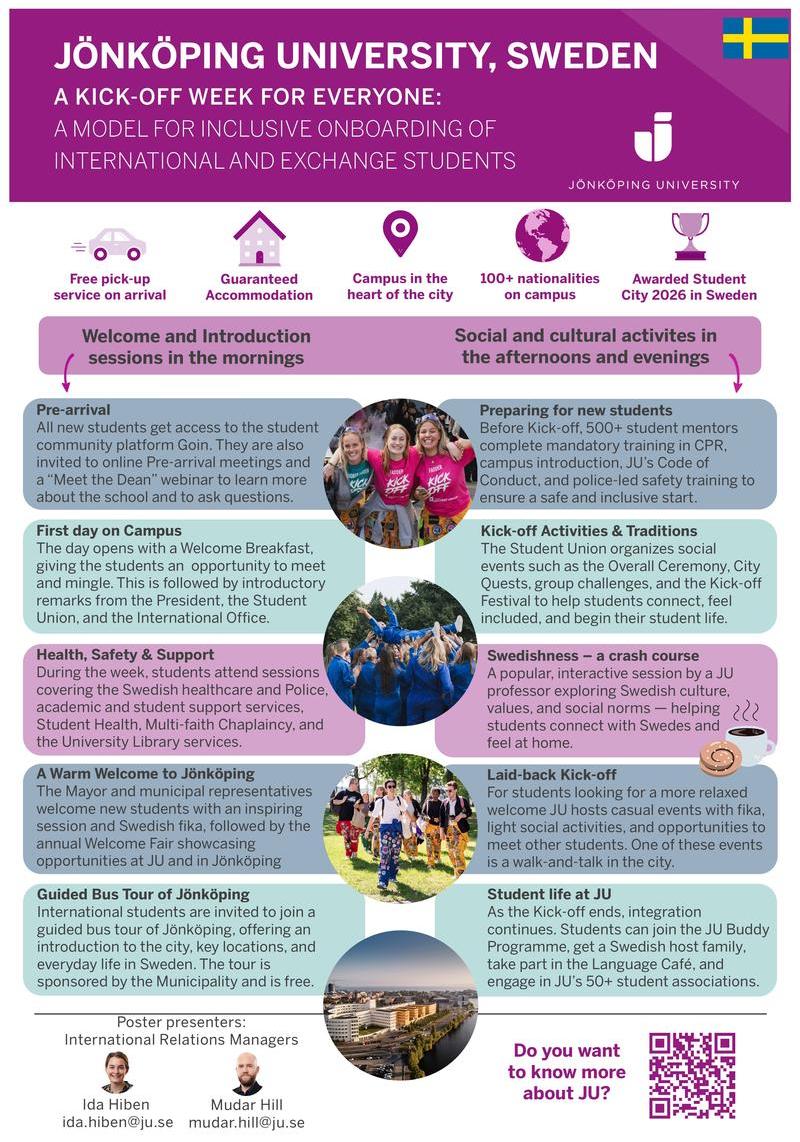
Welcoming international and exchange students is about much more than logistics. At Jönköping University (JU) in Sweden, our Kick-off Week is designed as a structured, inclusive onboarding process that helps students feel safe, informed and socially connected from day one. This poster presents a model that other institutions can adapt– regardless of size, budget or national context.
The core idea: Inclusion starts before arrival
One key takeaway from our poster is that successful onboarding begins well before students set foot on campus. At JU, all new students gain early access to a student community platform, participate in online pre-arrival meetings and are invited to webinars such as "Meet the Dean." These early touchpoints reduce anxiety, build trust and ensure students arrive with realistic expectations.
What you can apply: Introduce at least one structured pre-arrival activity that combines practical information with a human face – not just emails and PDFs.
Balancing structure and flexibility
Kick-off Week at JU clearly separates academic and administrative sessions in the mornings from social and cultural activities in the afternoons and evenings. This rhythm respects students’ energy levels and allows them to choose how much they want to engage socially without missing essential information.
What you can apply: Create a predictable daily structure so students know when they need to focus and when they can socialise or rest.
Safety, health and support as foundations – not add-ons
In spirit of JU´s vision "People First", rather than treating health, safety and student support as peripheral topics, JU places them at the heart of Kick-off Week. Sessions with healthcare services, the police, student health, library services and multi-faith chaplaincy signal that well-being and inclusion are institutional priorities.
What you can apply: Shift key support information from websites into live sessions during onboarding, and frame them as resources – not emergency measures.
Collaboration beyond the institution
A distinctive aspect of JU’s model is collaboration with external stakeholders, such as the municipality. The Mayor’s welcome, a free guided bus tour and a Welcome Fair to introduce students to life beyond campus. This helps students feel part of the city – not just the institution.
What you can apply: Involve local partners (municipality, transport providers, cultural organisations) to strengthen students’ sense of belonging.
Inclusion through choice and representation
Not all students enjoy high-energy social events. JU therefore offers a "Laid-Back Kick-off" alongside more traditional student activities. Cultural sessions such as "Swedishness – a crash course" help students understand local norms in a humorous, low-threshold way. Integration then continues through buddy programmes, host families, language cafés and student associations.
What you can apply: Design onboarding with multiple entry points to make sure all students feel welcome and get the opportunity to meet others.
Preparing those who welcome others
JU’s Kick-off Week is supported by more than 500 volunteer student mentors. Each mentor team, consisting of current JU students, guides a group of new students during the introduction period, helping them settle in both academically and socially. Before taking on this role, all mentors take part in a preparation program which includes CPR and safety training, team building and inclusion, and the university’s code of conduct.
What you can apply: Treat student mentors as key actors in the onboarding process and prepare them accordingly.
Inclusive onboarding is not a one-week event, it is a continuous process that begins before students arrive and lays the foundation for their success, wellbeing, and sense of belonging. By combining pre-arrival engagement, structured programming, local collaboration, flexible participation opportunities, and well-prepared student mentors, higher education institutions can create a welcoming and inclusive start to the student journey.